The damage builds where you never look.
A washer hose, a dishwasher seal, or a water-heater tank rarely fails all at once — it seeps for weeks behind and beneath the unit before you notice. By then the floor and wall are already soaked. We find the hidden damage and dry it properly.
The slow ones do the most damage.
Appliances leak in two ways, and both are traps. A slow one — a weeping supply hose, a failing dishwasher gasket, a rusting water-heater tank — seeps unseen for weeks into the subfloor and the wall behind the unit, so the damage is done long before a puddle appears. A sudden one, like a burst washer hose or a tank that lets go, floods the room in minutes.
Either way, the water goes where you can't see it: under the cabinet, beneath the flooring, into the cavity behind the appliance. We use thermal imaging and moisture meters to map exactly how far it traveled — because a floor that feels dry on top can be soaked underneath.
The quiet signs an appliance is leaking.
A slow appliance leak can run for weeks before it floods. If you notice any of these near a washer, dishwasher, fridge, or water heater, call — early is the difference between a dry-out and a rebuild.
Buckling or discolored flooring
Warping, staining, or a soft spot in the floor near an appliance means water has been working underneath for a while.
A musty smell near the unit
A persistent damp or musty odor around a washer, dishwasher, or water heater is often the first sign of hidden moisture.
Rust, corrosion, or pooling at the base
Rust streaks on a water-heater tank or a small puddle at an appliance's base are early warnings the seal or tank is failing.
Stains on the ceiling below
A second-floor laundry or a dishwasher over a finished room shows its leak as a spreading stain on the ceiling underneath.
Stop it, pull it, trace it, dry it.
Our own crews handle emergency mitigation start to finish. For rebuilds, we manage every trade under one accountable team. Appliance-leak restoration stays on one managed schedule from shutoff through rebuild.
We stop the water
First through the door, we shut off the supply to the failing appliance — the washer valve, the dishwasher line, the water-heater feed — so nothing keeps leaking while we work.
We trace where it went
Thermal imaging and moisture meters find the water hiding under the cabinet, beneath the flooring, and inside the wall behind the unit — so nothing gets closed up wet.
We extract and dry to a number
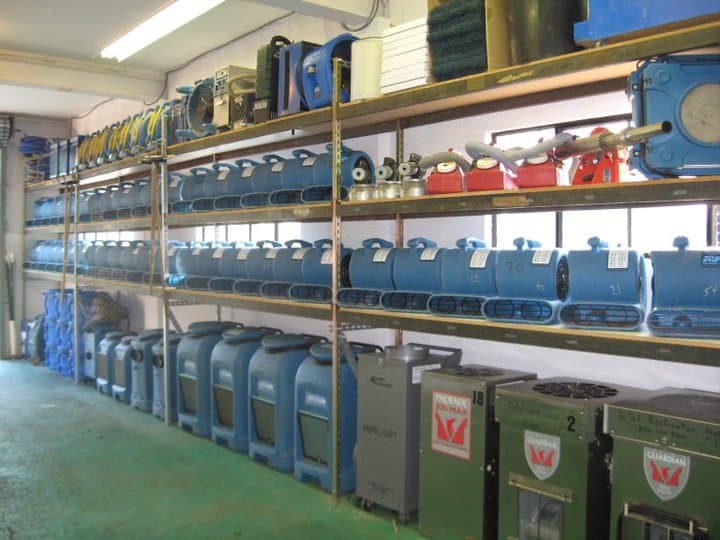
Work performed to IICRC S500 standards. We pull the standing water, then air movers and Phoenix 200 MAX dehumidifiers dry the subfloor, cabinet, and wall cavity, tracked on a daily moisture log.
We treat and rebuild
Antimicrobial goes on every affected surface, including hidden framing and subfloor; then TRC manages flooring, cabinetry, and drywall on the same schedule.
Appliance-leak questions, honestly answered.
Coverage depends on the cause and policy; sudden failures and known slow leaks may be treated differently. We document losses and coordinate with insurance carriers. We bill your insurance directly.
Very possibly. Appliance leaks do their worst work underneath and behind the unit, where a floor can feel dry on top while the subfloor and wall cavity are soaked. That's exactly why we map it with thermal imaging and moisture meters rather than trusting the surface.
Often, if drying starts early. Hardwood can sometimes be dried in place before it cups permanently, and a subfloor dried quickly may not need replacing. Laminate and engineered flooring are less forgiving once water gets under them. The longer it sits, the lower the odds.
A slow drip gives you a little time; a tank that has failed and is dumping water is an emergency. Either way, shut off the water supply to the heater if you safely can, then call us. A failing tank rarely gets better, and the surrounding structure keeps absorbing water until it's stopped.
It depends on how long the leak ran and how far it spread, but a contained appliance leak is typically a shorter dry-out than a whole-room flood. We monitor moisture daily and pull the equipment only when the subfloor and walls confirm genuinely dry.
More on water damage restoration.
Explore More
Restoring Your Life Back To The Way It Should Be.
A hidden appliance leak won't dry itself.
A real person answers 24/7.