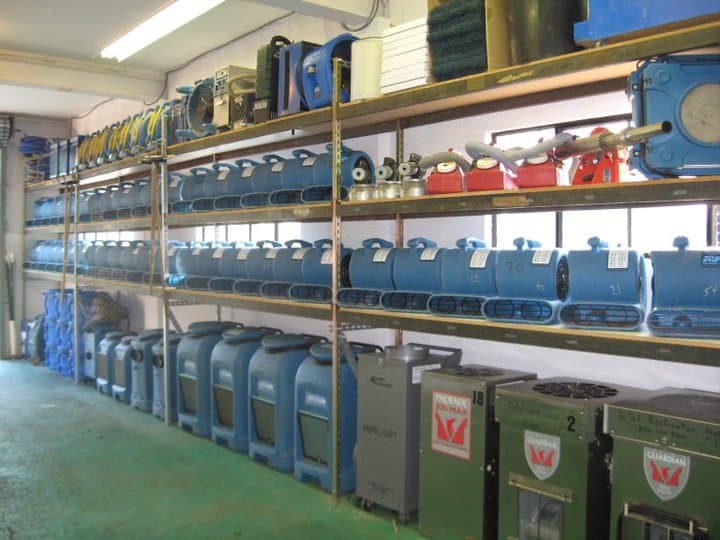
A damp basement is mold’s favorite address.
Below-grade spaces run humid and stay cool, and that combination lets mold settle in slowly and quietly. We remove what's there — and just as important, we go after the humidity and seepage that made your basement a place mold wanted to live.
It's rarely a flood — it's the humidity.
Basement mold usually isn't the result of a dramatic leak. It's the slow stuff: high humidity that never dries out, water wicking through block or stone walls, condensation on cool surfaces, a little seepage after every heavy rain. Given that steady moisture and something to feed on, mold establishes without anyone noticing — behind finished walls, under stored boxes, along the sill.
Removing the visible growth without addressing why the space stays damp is why so many basements grow it back. Finding the moisture path — the seepage point, the humidity source, the unseen wet spot — is the part we lead with, because it's the only thing that keeps the basement dry after we leave.
Signs your basement has a mold problem.
Basement mold tends to announce itself by smell and feel long before you spot it. If any of these are familiar, an inspection is the honest way to know how far it's gone.
That basement smell
A persistent musty, earthy odor is the most common first sign — it usually means active growth somewhere out of sight.
Damp or stained walls after rain
Darkening, chalky residue, or moisture on block and stone walls points to seepage that keeps materials wet.
Growth on stored boxes or furniture
Cardboard, fabric, and wood store moisture and feed mold — spotting on them signals the room’s humidity is too high.
Condensation on pipes or walls
Beads of water on cool surfaces mean the humidity is high enough for mold to thrive, even without an obvious leak.
Find the moisture, then remove the mold.
Our own crews handle emergency mitigation start to finish. For rebuilds, we manage every trade under one accountable team. We manage basement remediation from tracing the dampness through documented completion and optional independent verification.
We find why it stays damp
Thermal imaging and moisture meters trace the seepage, wicking, or humidity feeding the growth. In a basement, the source is the whole job.
We contain the work zone
Containment barriers and negative-air machines seal the affected area — critical in a basement, where spores otherwise ride the air currents straight up into the rest of the house.
We remove it under HEPA filtration
Affected drywall, framing, and stored materials come out bagged under containment, and HEPA air scrubbers and vacuums capture the spores the work kicks loose.
We treat, dry, and can arrange verification
We treat affected materials and protocol-specified surfaces, dry the source moisture to a measured standard, and can arrange independent third-party post-remediation verification when appropriate.
Basement-mold questions, honestly answered.
Almost always because it stays damp — high humidity, seepage through the walls, or condensation on cool surfaces. Remove the mold without fixing that, and it returns. That's why we lead with finding the moisture path, not just clearing the growth.
Yes. Non-porous surfaces like sealed concrete can often be cleaned and treated in place under containment; porous or heavily colonized materials get removed. Either way, the moisture correction is what keeps it from returning.
It can be. Spores don't respect the door at the top of the stairs — basement air moves up into the living space. If there's active growth or a strong musty smell, it's worth an inspection even in an unfinished space.
Controlling humidity is a real part of keeping mold away, but a dehumidifier alone won't remove growth that's already established or stop active seepage. It's one tool; proper remediation plus fixing the water path is the actual solution.
It depends on the cause. Mold from a sudden, covered event — like a burst pipe — is often covered; mold from long-term humidity or seepage usually isn't. We document the source carefully because that's what decides your claim, and we'll tell you honestly where yours likely falls.
More on mold remediation restoration.
Explore More
Restoring Your Life Back To The Way It Should Be.
A dry basement is one you can trust again.
A real person answers 24/7.