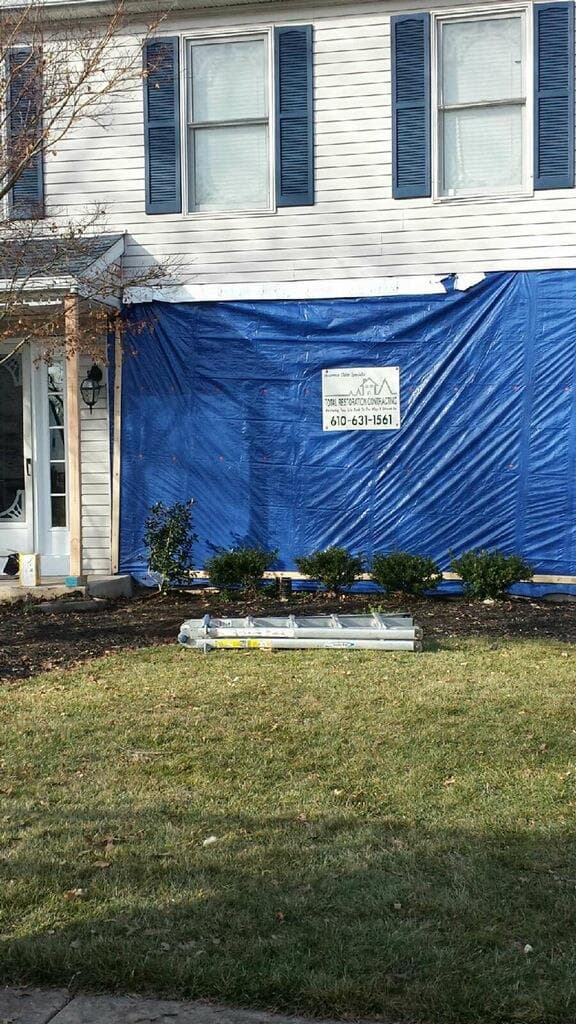
The fire is out. The house is still open.
Firefighting leaves a home exposed on every side — smashed windows, forced doors, ventilation holes cut in the roof. Until it's sealed, weather and trespassers keep adding to a loss that's already big enough. We secure it and tarp it, day or night.
The second loss starts the moment the trucks pull away.
Putting a fire out means breaking the house open: windows are vented, doors are forced, and holes are cut in the roof to let heat and smoke escape. Those openings don't close themselves — and a burned-out home with no one watching it draws exactly the wrong attention.
The next rain drives straight through the roof onto floors that firefighting already soaked, spreading water and soot damage into rooms the fire never reached. We keep plywood, framing lumber, and roof tarps staged at our Limerick shop to support emergency response after the fire marshal releases the property.
Every way a fire leaves a home open.
If the fire department was here, some of these are true right now. Any one of them is a reason to call before the weather does.
Vented and broken windows
Glass broken to release heat and smoke leaves openings on every affected side of the house.
Holes cut in the roof
Ventilation cuts let firefighting work — but they also let the next rain straight into the structure.
Forced or missing doors
Doors broken off their frames for entry leave the home unsecured at ground level, the easiest way in.
A house that looks abandoned
A dark, burned property with no one around reads as an easy target — securing it visibly changes that.
A coordinated board-up and roof-tarping response.
Our own crews handle emergency mitigation start to finish. For rebuilds, we manage every trade under one accountable team. We manage board-up, smoke cleanup, and rebuild as one coordinated job.
We coordinate with the fire marshal
We won't enter or secure the property until it's been released as safe. Once it's cleared, we confirm the response plan and keep you updated.
We seal the openings
Vented windows, forced doors, and wall breaches get plywood or OSB, framed and fastened into sound structure — built to hold, not just look closed for the afternoon.
We tarp the roof
Ventilation holes cut during firefighting are covered with weather sheeting and roof tarps so the next rain stays out of a structure that's already soaked.
We post the TRC sign
Our sign goes on the board-up — it tells neighbors the property is being handled, not abandoned, and tells you exactly who to call for the rest.
We document it same-day
Timestamped photos and a record of what we secured, sent the same day so your insurance claim starts with a clean record of the mitigation.
Post-fire board-up, honestly answered.
Emergency calls are prioritized, with materials staged at our Limerick shop. We wait for the fire marshal to release the property as safe; after release, we're typically on-site within two hours — often sooner — for emergencies.
In most cases, yes. Board-up and tarping are emergency mitigation — work you're expected to do right away to prevent further loss — and that's typically covered, often before the main fire claim is fully opened. We document it the same day so it's easy to substantiate.
Yes — the roof is usually the most urgent part after a fire, because ventilation holes let rain into an already-soaked structure. The response plan can include weather sheeting and tarps along with securing the other openings.
It looks handled. We use properly sized sheet goods framed into solid structure, and our sign goes on it — so neighbors and passersby see a property that's being cared for, not one left open.
Yes. Our own crews handle emergency mitigation start to finish. For rebuilds, we manage every trade under one accountable team. We manage board-up, smoke and soot cleanup, drying, and rebuild on one schedule.
More on emergency board-up restoration.
Explore More
Restoring Your Life Back To The Way It Should Be.
The fire's out, but the house is still open.
A real person answers 24/7.